
Kaitlyn Aurelia Smith:
The shape of what remains with Rev OCEAN, MiniFreak and KeyStep
Kaitlyn Aurelia Smith’s music draws on classical training, years of exploration with modular synthesizers and a deeply physical relationship with sound. The American composer, producer and synthesist brings these experiences into intricate electronic arrangements, orchestral passages and a voice transformed through processing. Her live set has evolved from touring with Buchla systems to a more lightweight setup built around sampled instruments, synths and controllers. This opens new ways to layer, loop and reshape sounds while preserving the hands-on approach that guides her music.
We joined Kaitlyn on the Atlantic coastline to explore her creative process and the ideas behind her forthcoming album, alongside a vivid performance of GTP! shaped with Rev OCEAN, MiniFreak and KeyStep.

A physical understanding of sound
Kaitlyn’s route into music began with a curiosity about its physical workings. At fourteen, a mentorship with a recording engineer revealed the dynamics between frequencies and the spaces they occupy, inspiring a future as an acoustician. Her formative years included other observations and experiences of music that drove that curiosity further, going on to teach herself piano and study sound engineering and classical guitar.
The connection she describes between sound and bodily sensation, like a form of synesthesia, remains integral to her composition. Her technical knowledge gives her ways to pursue a feeling in detail; whether through a harmonic progression, the resonance of a synthesizer or the changing and mutable character of her voice.
Modular synthesis became part of that exploration after her studies, when a neighbor on Orcas Island lent her a Buchla 100. She lived with the instrument in her cabin for about a year, learning its possibilities through sustained listening and experimentation. Recreating everyday sounds became a way to understand how a sound’s movement and character could be constructed electronically.
There was a long time where I was practicing replicating how to make on a synthesizer the sound of a door opening or a bird flying by. And a lot of that intentional practice of mimicking the world taught me a lot about how sounds work.
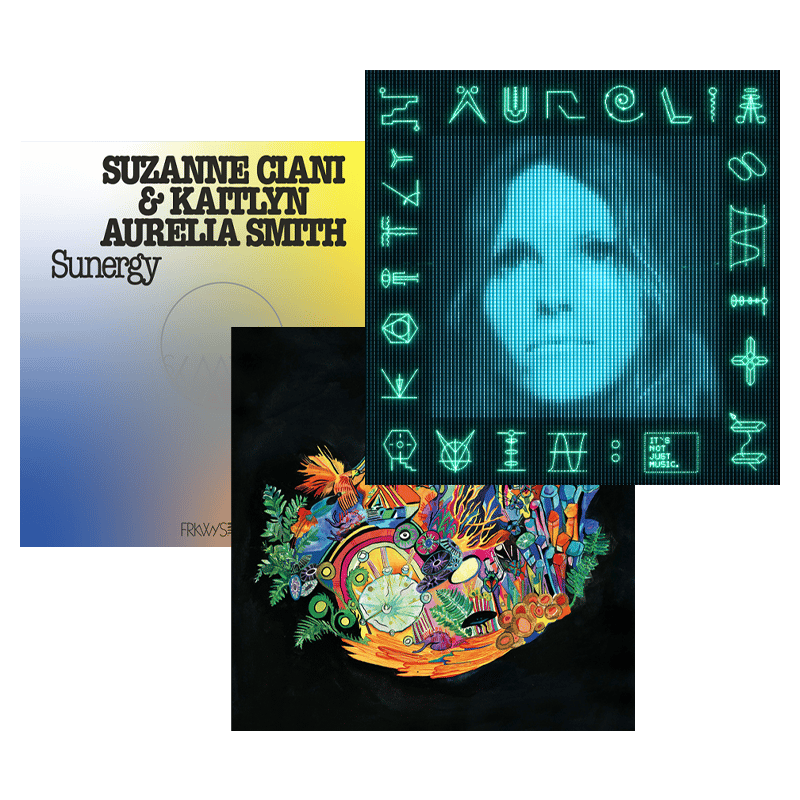
Buchla synthesis would become central to Ears and Sunergy, her 2016 collaboration with Suzanne Ciani where a shared affinity for the instrument developed into an improvised musical exchange. More recently, GUSH brought a greater emphasis on songwriting and an exploration of attraction, intimacy and tactile sensation. Across these different contexts, Kaitlyn continues to use composition to investigate experiences she wants to understand more fully, allowing each record to develop its own musical language.
The potential left over
Kaitlyn was already exploring ideas around ruin and entropy when she moved to Portugal, where the buildings around her gave those questions a physical setting. She describes wondering what had impacted a building, what had created its ruin, while also sensing the nostalgic memory it held. Those impressions informed the sonic impact and orchestral passages of Ruin: It’s Not Just Music, her new album, out October 2, 2026.
Working with that theme also brought her back to her own musical history. Her slower, atmospheric compositions and classical background became material she could take apart and approach through the drum and bass direction of the record.
Nothing can really get ruined unless you abandon it. That there’s always potential left over. And so a lot of the new album is taking a sound and ruining it and then seeing what’s left of it. And I had a lot of fun taking some memories of my more slower atmospheric music and my more classical background and ruining it and turning it into a drum and bass inspired album.

The language accompanying the release is physical and direct: “sonic martial arts,” “catharsis,” music “created in the aftermath & aftershock.” In the interview, Kaitlyn speaks about the experiences behind that language, describing a period when continuing to make music had itself become a question.
I feel like this album that I’m about to release is maybe the biggest turning point for me because it came from a lot of external things leaving me in a place that made me feel ruined and I really wanted to give up on music. And it felt like a turning point of instead of giving up to use that potential of what still remains when something is ruined and to make music out of it.
She connects those feelings to difficult experiences in the music business, but her intention for the record reaches beyond her own circumstances. The “sonic forcefield” is something she wanted to offer other artists with an understanding of how much of a person’s life can be involved in making and sharing their work.
I think a lot of people don’t think about what it takes for an artist to share music. It’s not just that moment of making music. It’s an existential journey and a psychological, emotional experience. And so instead I channeled my own experience of that into wanting to make a music that felt like a force field, a force field for all artists that feel taken advantage of and all people that are in that energy right now.
Rev OCEAN: Making space into an instrument
Kaitlyn’s early interest in acoustics remains present in the way she constructs an arrangement. Space has a character of its own in her music, shaped through the interaction of frequencies, phasing and formants to create the impression of a resonating body. Her experience in sound engineering gives her ways to work with those relationships in detail.
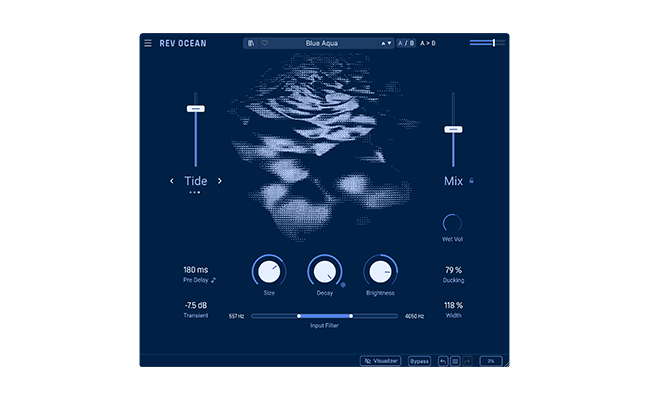
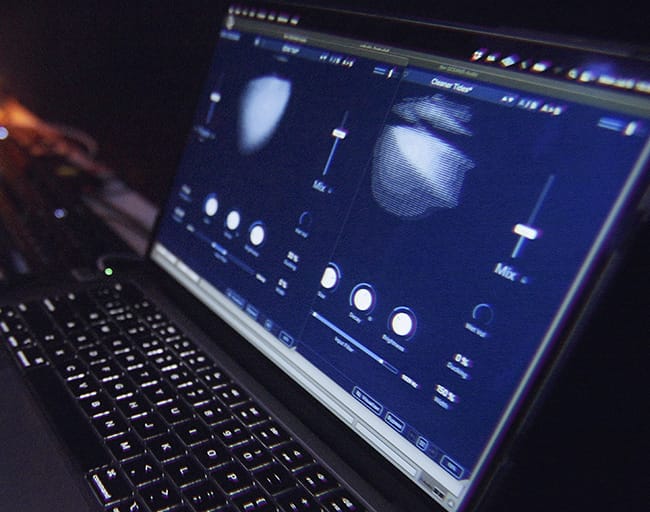
Reverb enters that process selectively. What draws her to Rev OCEAN is its even spread of frequencies and the control it offers over the movement of resonance, allowing her to develop the spatial qualities she hears in a sound. In the introduction and outro of GTP!, it helps establish the environment around the performance.
Rev OCEAN created a container, which is something that I’m always looking for in an effect, where it creates the feeling of a room, the feeling of a space that sound can bounce off of.
She shapes that environment through two instances of Rev OCEAN, with mix, wet level and decay mapped to knobs on her OP-1. Each movement adjusts both instances as she plays. Sensitive to sharp resonance, she works with the pair until the decay has what she describes as a hollow middle, finding a balance that feels comfortable to her ears.
Those adjustments also give her material to use elsewhere in the arrangement. Sampling the moments between phrases, she captures the reverb tail and keeps it as a sound effect in the background. The resonance around a part becomes another layer she can work with independently.
Her attention extends to the effect of removing that space. A consistent reverb can become so familiar that the listener stops consciously hearing it; taking it away changes the relationship between the sounds that remain. Kaitlyn uses that shift to open up another part of the song, making the listener’s growing familiarity with an atmosphere part of the arrangement itself.
MiniFreak: Texture in motion
When Kaitlyn encounters a synthesizer, she is interested in the intentions and decisions that have gone into it. Spending time with its particular capabilities gives her a starting point for composition, allowing the instrument’s character to influence what she makes.
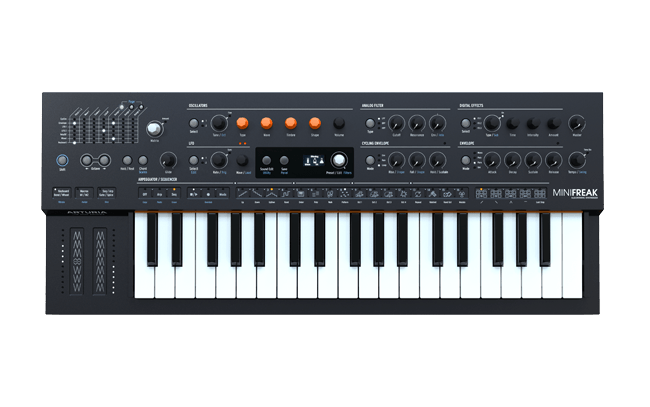
MiniFreak’s modulation matrix initially drew her attention. Coming from modular synthesis, she values the ability to reconfigure connections within a sound, bringing that familiar way of working into a more compact instrument. Its hybrid design offers a combination of ready-made relationships and access to change them, leaving room for her own configurations.
The granular textures she hears in MiniFreak have also found a place alongside the analog sources in her setup. Layering them gives her another way to shape a sound’s presence across the frequency range.
I feel like it adds a lot of texture to a lot of analog sounds. So, I like to sometimes double it with analog sounds so that it can add something more mid range that will come through on computer speakers and on smaller speakers. And also just give a lot more personality.
She often distributes those layers across different octaves, finding a more organic quality in the interaction of several voices. Her use of software alongside hardware follows a related approach. The differences between an emulation and its analog counterpart can contribute to the combined sound, giving her a reason to listen to both together.
As she became more familiar with MiniFreak, its arpeggiator and tactile controls took on a greater role in her playing. In GTP!, an atmospheric arpeggiated part is treated with Rev OCEAN, while other arpeggiated and bass sounds begin with presets she adapts for the piece. The performance develops through both the preparation of those sounds and the changes she makes to them under her hands.
Pressing combinations of the arpeggiator controls lets her interrupt a pattern and hear how it responds. Mutate is particularly useful for the brief accents she introduces on both MiniFreak and KeyStep: depending on the sound, she describes a momentary sense of explosion that gives a transition its energy.

KeyStep: Keeping the performance in motion
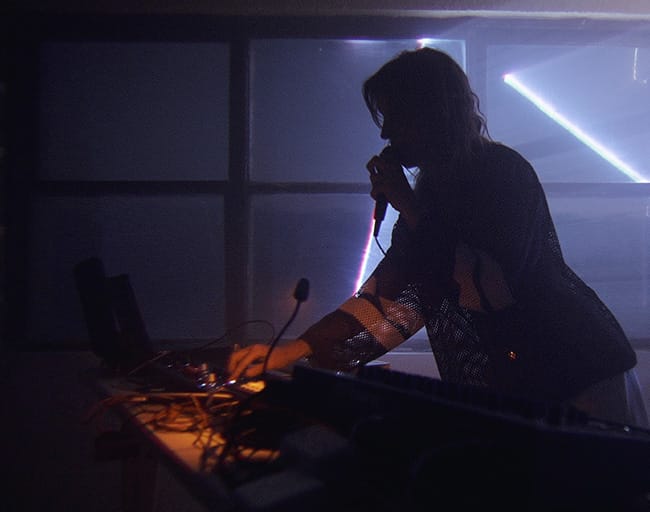
The sampled instruments in Kaitlyn’s live set begin with the analog synthesizers she works with at home. Bringing those recordings into samplers allows her to carry their sounds into a lighter touring setup, where controllers give her several ways to play and rearrange the material.
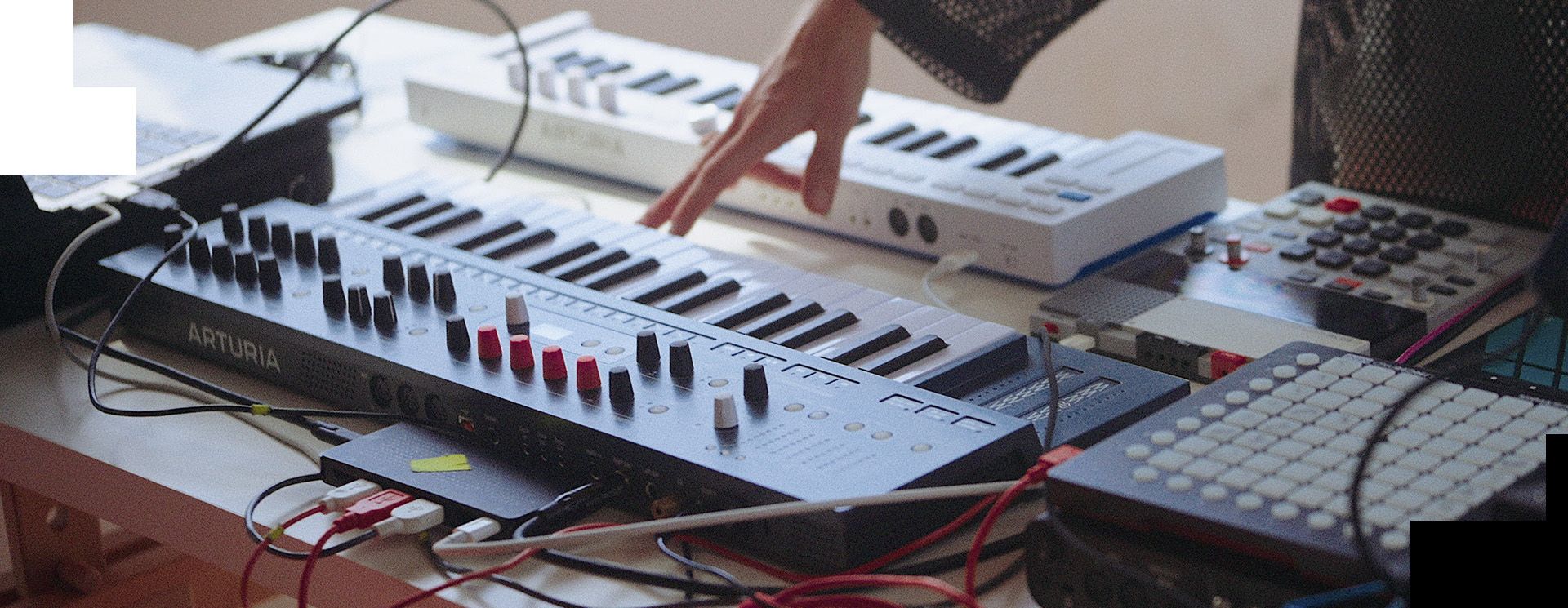
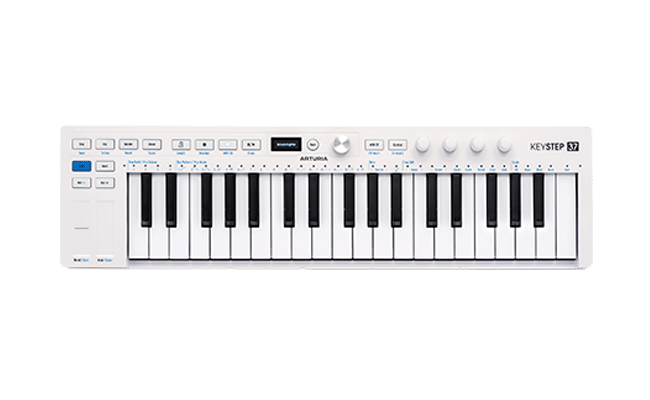
KeyStep provides a reliable connection to those instruments. Its sturdiness matters after years of traveling with gear, while the ability to play basslines and melodies manually keeps her background as a pianist present in the performance. The sequencer and arpeggiator become part of that physical relationship, allowing her to move between playing a phrase and working with its continued motion.
I tend to go between the sequencer and the arpeggiator. And I like to play a lot of parts live because I do a lot of live looping. And it keeps it really interesting for me as a musician when I’m performing.
In GTP!, she uses KeyStep to generate the main arpeggios, treating them with effects before looping and sampling them. Once a phrase is captured, she can change the sound assigned to the keyboard and begin playing a voice sample while the earlier part continues. Its role develops with the arrangement, keeping new material available beneath her fingers.
That flexibility also informs the layout of the wider setup. Kaitlyn repeats functions across different stations, giving herself access to the same sampling and control options wherever she happens to be playing. Decisions about where a sound will appear can then be made in the moment, with several routes through the performance available to her.
Preparing material in one setting and developing it in another has long been part of her work. During residencies with rare synthesizers, she has used Arturia software instruments to explore ideas on flights and prepare MIDI before arriving. The limited time available with the hardware can then be spent working with music she has already begun, much as the sounds recorded at home remain open to change when she takes them onstage.

“Simultaneously feeling in control but with a lot of room for being out of control. And I feel like that’s the fine line of when flow happens, when you’re perfectly riding the edge of control and out of control.”
Another beginning
In Kaitlyn’s music, a sound rarely stays in the form it began with. A voice can become a character with a different imagined body, a synthesizer part can become a sample, and the space around it can become something to play. Rev OCEAN, MiniFreak and KeyStep each enter that process at a different point, helping her shape an environment, introduce a new texture or keep an evolving arrangement beneath her fingers.
Underpinning that fluidity is a long-held love of practice. Kaitlyn works on her muscle memory so that she can find the chord for a feeling the instant it arrives, much as a dancer trains for years in order to simply feel the moment. What excites her most is entering music on the assumption that she does not know what will happen next, ready to hear something she has never heard before.
What stands out to me is that regardless of where you look it’s always quality.